
The Broken Palate Guide to Steaks
(For People Who Actually Know Steaks) + our 5 favorite steakhouses
The Cut Matters Less Than You Think. The Grade Matters More.
Most people walk into a steakhouse obsessing over ribeye versus New York strip. But the conversation should start with grade. USDA Prime represents roughly the top 2% of all beef produced in the United States. Choice is solid. Select is what you’re getting at the supermarket and pretending you didn’t notice.
The difference is marbling, which is just a polite word for intramuscular fat. More marbling means more flavor, more juice, more of everything you showed up for. A Choice ribeye will always lose to a Prime strip.

“People come in and say they want the leanest cut, then wonder why it doesn’t taste like what they had last time when it was a steak with amazing fat marbling,” says David DiSalvo, Executive Chef at Bowery Meat Company. “The fat is the flavor. That’s not an opinion. That’s just how it works.”

A Quick Guide to the Cuts
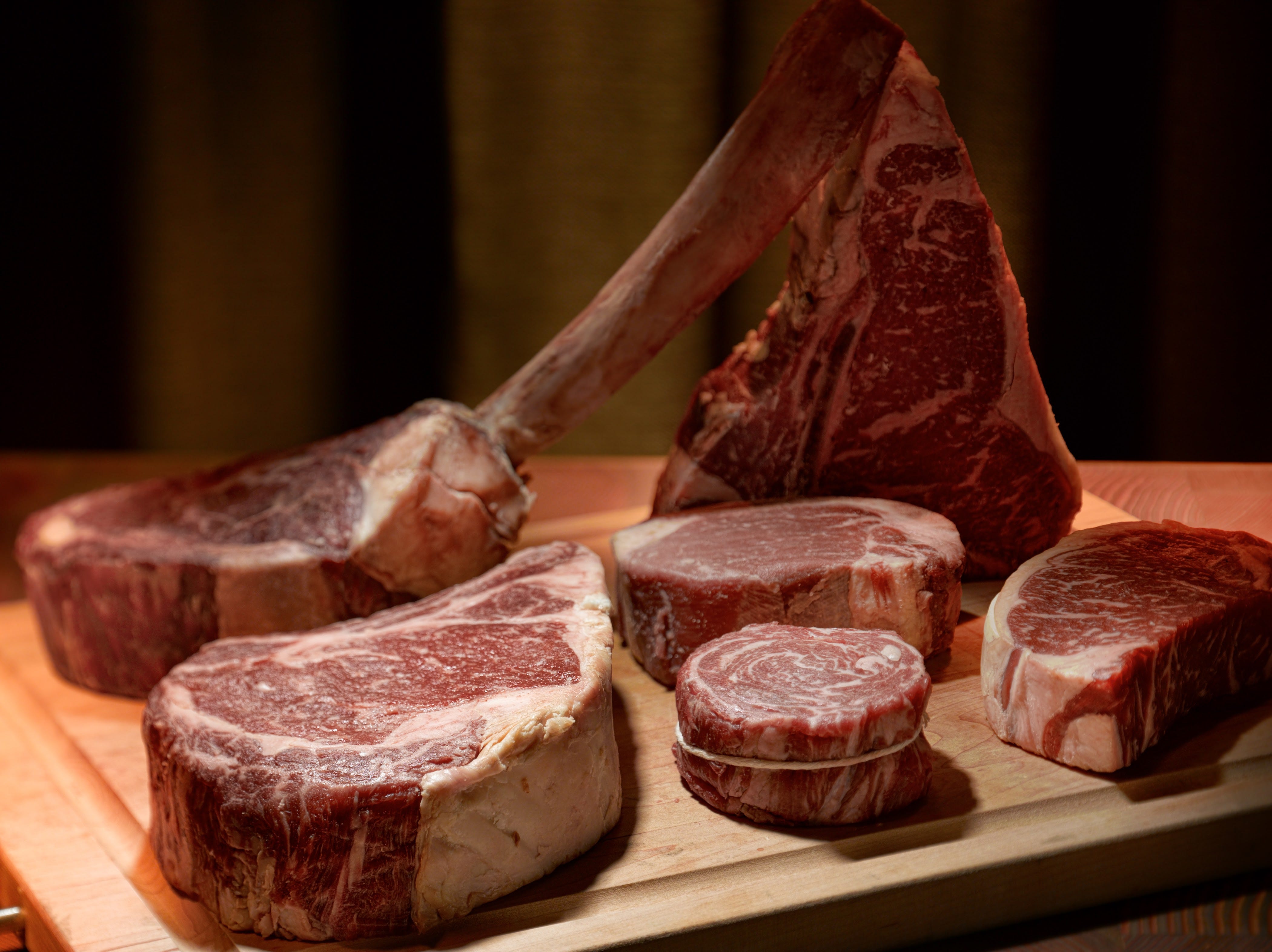
Ribeye. Heavily marbled, rich, almost buttery when it’s cooked right. The spinalis (that outer cap of fat and muscle) is genuinely one of the best bites of beef on the planet. If your steakhouse serves a tomahawk, that’s a ribeye on the bone with a long frenched rib.
New York Strip. Firmer than a ribeye, with a thick cap of fat running along one side. This is the steak for people who want flavor but also want to feel like they’re eating actual meat, not beef butter. A strip tells you more about the quality of the restaurant than almost any other cut because there’s less marbling to hide behind.
Filet Mignon. Tender, yes. Flavorful, not especially. It comes from the tenderloin, a muscle that does almost no work, which is why it has the texture of a cloud and the beefy depth of one too. Great steakhouses will compensate with a serious sear and maybe a bone marrow butter.
Porterhouse and T Bone. Same cut, different sizes. You’re getting a strip on one side of the bone and a filet on the other. The porterhouse just has a larger filet portion. It’s the best of both worlds if you genuinely can’t decide and also don’t mind paying for two steaks at once.
Hanger. The butcher’s cut. There’s only one per animal, which is why you don’t see it everywhere. Loose grained, deeply beefy, and best at medium rare or below. DiSalvo calls it “the most under appreciated cut in the case. It eats like a ribeye at half the attitude.”
Dry Aged vs. Wet Aged: The Argument That Never Ends
Wet aging is simple. The beef sits in its own juices in a vacuum sealed bag for a few weeks. It gets more tender. It tastes like very good beef.
Dry aging is a commitment. The beef hangs in a controlled environment, losing moisture over weeks (sometimes months), while enzymes break down the muscle. The result is concentrated, funky, almost nutty. A 45 day dry aged ribeye tastes nothing like a fresh one. It tastes like beef that went to graduate school.
Most serious steakhouses dry age in house. If they do, they’ll tell you. Loudly.
The Temperature Conversation
Order what you want. But know this: rare to medium rare (120°F to 135°F internal) is where you get the fullest expression of what that cut actually is. Past medium, you’re essentially cooking out everything that made it worth the price.
A good kitchen will also let the steak rest before it hits your table. If it arrives in a pool of liquid, it wasn’t rested. That’s not juice on your plate. That’s money.
Table tip
Ask your server what the aging program looks like. Ask if they butcher in house. Ask where the beef comes from. Good steakhouses love these questions. Bad ones change the subject. And if you see a cut you don’t recognize, order it. That’s usually where the kitchen is showing off, and showing off at a steakhouse is almost always worth your time.

Our Five: The NYC Steakhouses Worth Your Time
These are five spots we keep going back to, each for a completely different reason. If you’re serious about steak in this city, start here.
Keens Steakhouse
72 W 36th St, Midtown Reserve on Resy
Open since 1885. Ninety thousand clay pipes hanging from the ceiling. A collection of Americana on the walls that could fill a small museum. Keens is the steakhouse that every other steakhouse in this city is quietly trying to live up to, and almost none of them do. The porterhouse is outstanding, but you came here for the mutton chop and you know it. Thick, almost absurdly tender, served with mint jelly that somehow doesn’t feel like a relic. The single malt scotch collection alone is worth a visit. This is old New York, the real kind, not the kind someone decorated to look that way.
Order this: The mutton chop. Always the mutton chop. Prime rib King’s Cut if you’re feeling reckless.
COTE Korean Steakhouse
16 W 22nd St, Flatiron Reserve on Resy
Simon Kim built something that shouldn’t work on paper: a Michelin starred Korean barbecue restaurant that also functions as a legitimate high end steakhouse. Smokeless Japanese grills are set into every table. There’s a dry aging room visible from the dining floor. The wine list runs past 1,200 labels. The Butcher’s Feast is the move for first timers, a prix fixe parade of USDA Prime and American Wagyu that the kitchen grills tableside.
Order this: Butcher’s Feast. Don’t overthink it.
Bowery Meat Company
9 E 1st St, East Village Reserve on Resy
Bowery Meat is the steakhouse for people who find most steakhouses a little boring. The room is moody and downtown without trying too hard. The cocktail program is genuinely good. And the menu wanders beyond the standard porterhouse playbook into territory that most traditional houses wouldn’t touch. The 40oz porterhouse is the anchor, and it’s excellent, but the octopus appetizer, the hash browns (crispy, shattered, almost potato rosti territory), and the bread pudding dessert are the things people actually can’t stop talking about. This is a New York Times two star Critics’ Pick running out of a space that feels more like a great downtown restaurant that happens to serve incredible beef.
Order this: Porterhouse for the table. Hash browns, no debate. Bread pudding to close.
Carne Mare
89 South St, Pier 17, Seaport Reserve on Resy
Andrew Carmellini’s Italian chophouse is doing something none of the other spots on this list are doing: making you forget you’re eating at a steakhouse. The space, designed by Martin Brudnizki, is two stories of Tuscan leather, Venetian mirrors, and views of the East River and the Brooklyn Bridge that genuinely stop conversation. The menu opens with oysters, carpaccio, and Sorrento arancini before it even gets to the beef. And when it does, the gorgonzola cured Wagyu strip is unlike anything else in the city.
Order this: Octopus carpaccio to start. The gorgonzola cured Wagyu strip. Tableside salad because the theater of it is half the fun.
Hawksmoor
109 E 22nd St, Gramercy Reserve on Resy
The London import that quietly became one of the best steakhouses in the city. Hawksmoor does things simply and does them extremely well. All natural beef from family farms across the Northeast, cooked over charcoal with nothing more than sea salt. No truffle butter. No wagyu flights. Just really, really good steak in a room with vaulted ceilings, stained glass, and emerald leather booths that make you feel like you wandered into a very expensive gentleman’s library.
Order this: Bone in prime rib or the porterhouse. Peppercorn sauce.
I started grammar school in Woodside one month after Pearl Harbor. Before that, my mother ( who was NYC native) would give me a whole $0.15 and tell me to play on the subway! (A nickel going, a nickel coming back, and a nickel for a hot dog,) Not any more!
During the late 60'ss I was working in Rockefeller Center, and would sometimes have lunch away from the Center. My two favorites were Jack Dempsey's (which I don't believe is still in business) and Keens. I' would always get the Mixed Grill at Keen's which was always perfect. I had stopped smoking in 1962, so I didn't girt a clay pipe, but 90,000. Wow!!!
I grew up in northern NJ about an hour from Times Square. That was when the city was a fun place. I moved to the west coast in 1966, and am now in northern Arizona.
The last time I was in Manhattan, was in 1982 where I had breakfast at the top on the Twin Towers celebrating my son's graduation from SUNY Purchase.
It's nice to see that at least something from that past era has survived,